
ScienceHeritage
A long record, most of it unwritten.
San and Khoi peoples used kanna for millennia before European explorers and settlers wrote about it.12 Much of that oral knowledge was eroded by conflict with settlers, genocidal raids against the San, loss of land, introduced diseases and acculturation.1 What follows is the written part, dated, with a source for every date.
Dated, with sources
Before written records
About 1660
The first documented reports, by Van Riebeeck, describe kanna as an item of Khoi trade.3
1685
1692
Commelin described its traditional use as a masticatory: something chewed.3
1738
About 1770
Thunberg also described kanna being chewed.3
About 1830
The Afrikaans names kougoed and kauwgoed, chew-stuff, were first recorded.3
1996
A review of 300 years of written records found no evidence that kanna or its alkaloids are hallucinogenic.4
2008
A review update reported wild kanna severely diminished by over-harvesting, poor veld management and possibly plant diseases.1
2010
2011
2013
2021
A review gathered the plant's taxonomy, history, chemistry, safety and regulation, including South Africa's rules on bioprospecting and benefit-sharing.3
Its names
Each name records who was speaking.
- Kougoed
- Afrikaans, from kou, to chew, and goed, stuff.3 It and its variant kauwgoed were first recorded in about 1830.3
- Sceletium
- The plant's name in English; the genus name reflects its skeletonized leaves.3
- Sceletium tortuosum
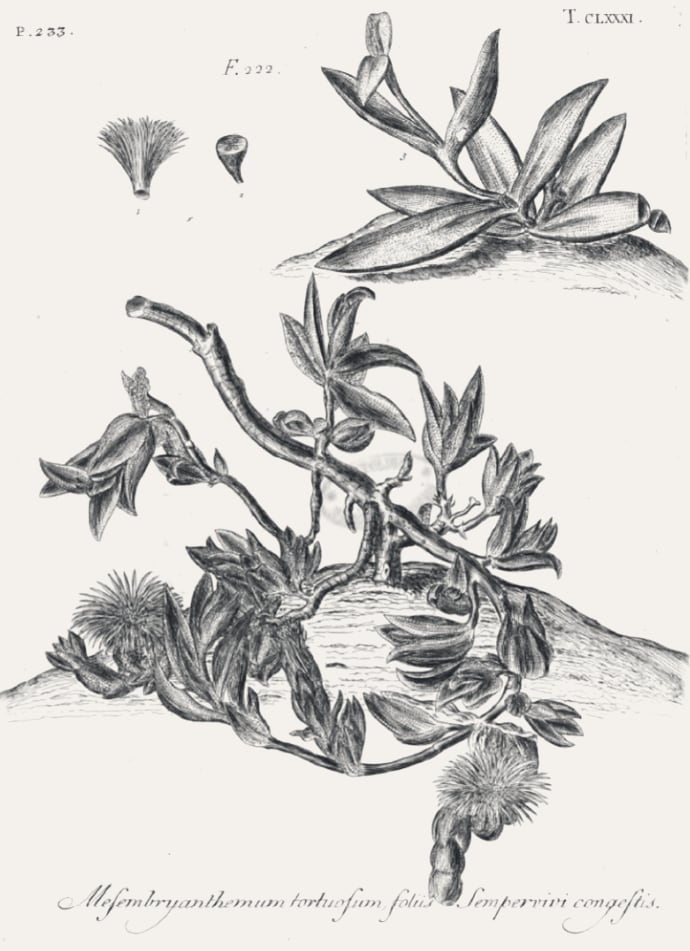
- The botanical name, also given as Mesembryanthemum tortuosum, in the family Aizoaceae.3

Who benefits
In South Africa, commercial bioprospecting of an indigenous plant needs a permit, and the benefits of indigenous knowledge must be shared.53 The rules sit in South African law, NEMBA, which covers bioprospecting, access and benefit-sharing for indigenous plants.3
In 2010 the first permit for a kanna extract went to one company, with a royalty-sharing agreement.5 Its named beneficiaries were the South African San Council and the Paulshoek and Nourivier Nama communities.6 That agreement covers that company's extract, not ours.5
Whether our supplier holds a permit and shares benefits is a question we have put to it. Until we have the documents, we will not imply that it does.
* Marks a statement about what kanna or its alkaloids did in published research, or how a historical writer described it. None of it is a claim about this product.
[?]These statements made have not been evaluated by the Food and Drug Administration. This product is not intended to diagnose, treat, cure, or prevent any disease.
References
Numbered in the order each source is first cited on this page. Titles are printed as their publishers printed them.
- Gericke N, Viljoen AM (2008). Sceletium--a review update. Journal of Ethnopharmacology 119(3):653-663. doi:10.1016/j.jep.2008.07.043 Back to the text
- Manganyi MC, Bezuidenhout CC, Regnier T, Ateba CN (2021). A Chewable Cure "Kanna": Biological and Pharmaceutical Properties of Sceletium tortuosum. Molecules 26(9):2557. doi:10.3390/molecules26092557 Back to the text
- Brendler T, Brinckmann JA, Feiter U, Gericke N, Lang L, Pozharitskaya ON, Shikov AN, Smith M, Van Wyk BE (2021). Sceletium for Managing Anxiety, Depression and Cognitive Impairment: A Traditional Herbal Medicine in Modern-Day Regulatory Systems. Current Neuropharmacology 19(9):1384-1400. doi:10.2174/1570159X19666210215124737 Back to the text
- Smith MT, Crouch NR, Gericke N, Hirst M (1996). Psychoactive constituents of the genus Sceletium N.E.Br. and other Mesembryanthemaceae: a review. Journal of Ethnopharmacology 50(3):119-130. doi:10.1016/0378-8741(95)01342-3 Back to the text
- SAnews (South African Government News Agency) (2010). 10 000 San to benefit from bio-prospecting license. SAnews, Government of South Africa (4 October 2010). www.sanews.gov.za/node/7216 Back to the text
- Sonjica B (Minister of Water and Environmental Affairs, South Africa) (2010). Speech at the handing over of the first bioprospecting permit to HGH Pharmaceuticals at Khwa Ttu San Cultural and Education Centre (1 October 2010). South African Government (gov.za). www.gov.za/news/speeches/speech-ms-buyelwa-sonjica-mp-minister-water-and-environmental-affairs-handing-over Back to the text
- Harvey AL, Young LC, Viljoen AM, Gericke NP (2011). Pharmacological actions of the South African medicinal and functional food plant Sceletium tortuosum and its principal alkaloids. Journal of Ethnopharmacology 137(3):1124-1129. doi:10.1016/j.jep.2011.07.035 Back to the text
- Terburg D, Syal S, Rosenberger LA, Heany S, Phillips N, Gericke N, Stein DJ, van Honk J (2013). Acute effects of Sceletium tortuosum (Zembrin), a dual 5-HT reuptake and PDE4 inhibitor, in the human amygdala and its connection to the hypothalamus. Neuropsychopharmacology 38(13):2708-2716. doi:10.1038/npp.2013.183 Back to the text
- Nell H, Siebert M, Chellan P, Gericke N (2013). A randomized, double-blind, parallel-group, placebo-controlled trial of Extract Sceletium tortuosum (Zembrin) in healthy adults. Journal of Alternative and Complementary Medicine 19(11):898-904. doi:10.1089/acm.2012.0185 Back to the text
- Dimpfel W, Gericke N, Suliman S, Chiegoua Dipah GN (2016). Psychophysiological Effects of Zembrin® Using Quantitative EEG Source Density in Combination with Eye-Tracking in 60 Healthy Subjects. A Double-Blind, Randomized, Placebo-Controlled, 3-Armed Study with Parallel Design. Neuroscience and Medicine (Scientific Research Publishing) 7(3):114-132. doi:10.4236/nm.2016.73013 Back to the text